



The history of Rugby Fives courts in British schools
Rugby Fives grew from the need to play a forceful, passing game in restricted school spaces. Its defining feature is the wall: a served or returned ball rebounds from a marked surface, creating a compact contest of angle, pace and control. The history of Rugby Fives courts in British schools is therefore a story about architecture as much as rules and playing traditions.
Early versions developed during the nineteenth century at institutions including Eton and Rugby School. Harrow and Charterhouse also became important homes of the game. Their courts were not standardised, so dimensions, service positions, scoring customs and the amount of open space around the wall could differ between schools.
Regular inter-school matches gradually transformed these local practices into a recognisable sport. Governing associations, improved hard surfaces and purpose-built courts made fixtures easier to arrange, while school archives preserve scorebooks, photographs and records showing changes in equipment, coaching and technique.
For an Australian audience, this British history offers practical lessons rather than a museum piece. Rugby Fives can complement rugby union, handball and other court sports, although a shared facility still needs suitable walls, markings, safe run-off areas and sensible player numbers. The sport’s future rests on caring for historic spaces while making new facilities welcoming from the first session.
School walls and local rules
Early fives courts often borrowed from buildings already within the school grounds. Masonry boundary walls, garden walls or specially rendered surfaces provided the rebound, while grass, gravel or cinder formed the playing area. Marks were simple because each school could decide where a player served and which wall contacts counted.
The early game also drew on handball and older forms of football. Some schools adopted four-wall handball conventions, while others used a more limited wall game resembling rugby. These differences produced familiar inter-school arguments over scoring and service, but they also gave individual institutions distinctive identities that survive in the names of historic courts and fixtures.
Victorian expansion and inter-school fixtures
During the late Victorian period, the construction of dedicated courts became a sign of a school’s sporting ambition. Walls were rebuilt to create consistent rebounds, additional courts accommodated several forms of fives, and painted lines replaced temporary chalk marks. The court increasingly became a focal point for competition, physical training and school social life.
House matches, annual challenges and public-school championships helped turn informal games into a structured calendar. Associations established common playing conventions, while scorebooks made results meaningful across schools. Spectators gained places along side walls or in viewing areas, making these enclosed grounds among the earliest examples of organised spectatorship in school sport.
Wartime disruption and postwar rebuilding
Competition was disrupted during both world wars, and fives courts sometimes became more useful for physical training, adapted exercises and informal play than for scheduled matches. Teachers and pupils returned the spaces to regular use afterwards, repairing walls, improving drainage and replacing worn grass or cinder with more durable hard surfaces.
Postwar development combined a fresh enthusiasm for school sport with practical rebuilding. Better line markings, rebound panels, nets and safety clearances improved the courts, while floodlighting and synthetic surfacing later extended their use. The result was a shift from picturesque school fixtures toward facilities capable of supporting regular competitive programmes.
| Period | Typical court construction | Markings and equipment | Main school function |
|---|---|---|---|
| Early nineteenth century | Existing masonry walls, grass and basic hard surfaces | Local chalk marks and rugby balls | House games and informal play |
| Late Victorian era | Dedicated rendered walls and additional courts | Painted service areas and shared scoring conventions | Inter-school and championship fixtures |
| Postwar period | Repaired walls, drainage and hard or synthetic surfaces | Durable line systems, nets and rebound protection | School teams, training and tournaments |
| Contemporary facilities | Regulation playing areas with purpose-built walls | Specialist balls, secure fittings and inclusive adaptations | Competitive, developmental and community use |
Standard courts and a national framework
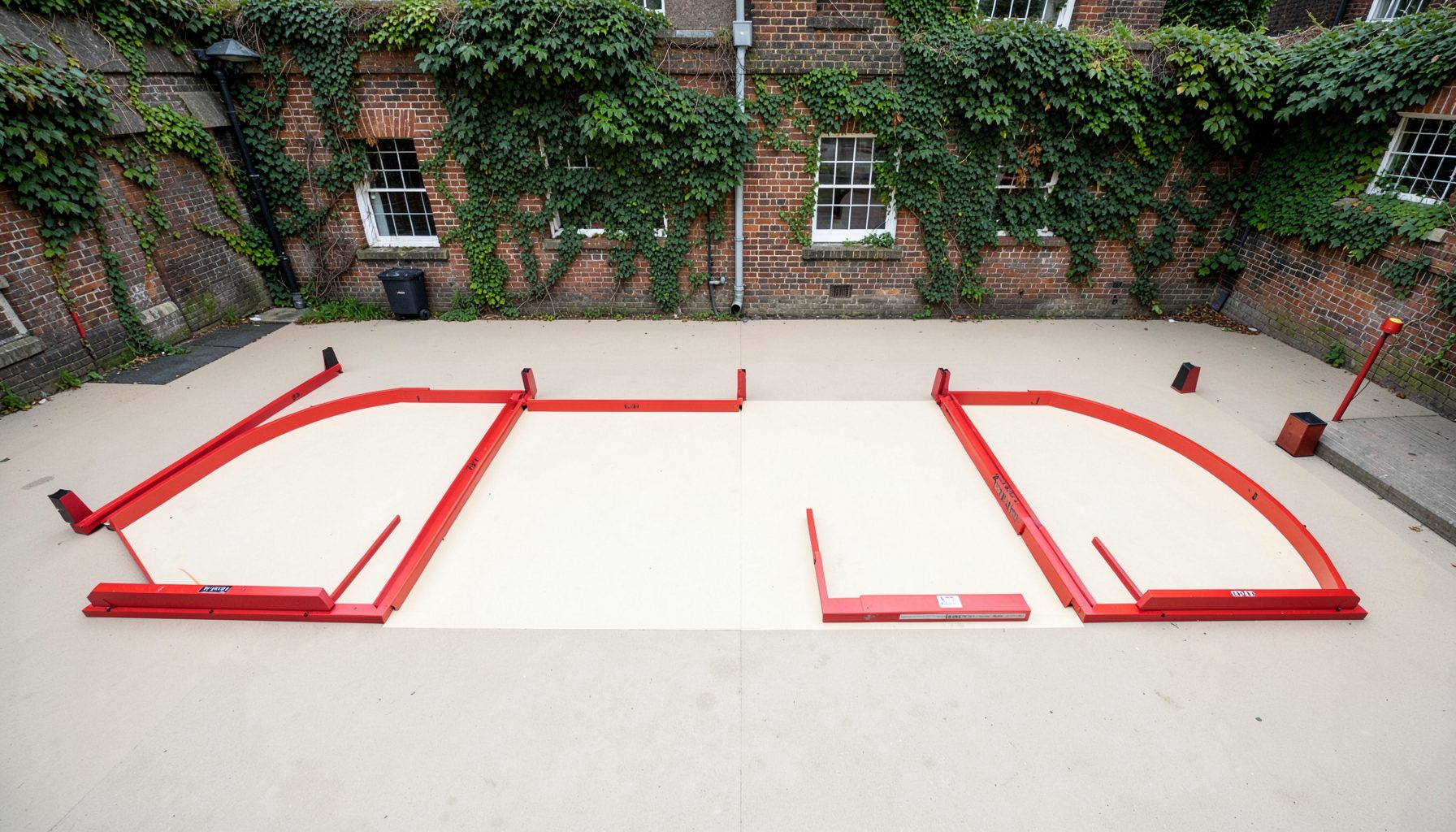
A modern outdoor Rugby Fives court generally uses a 20-by-10-metre playing area with a wall at one end, normally around 4.5 metres high. Standard service lines and designated areas have removed much of the ambiguity found in nineteenth-century school courts. The result allows teams to move between venues without relearning the dimensions of the game.
The Rugby Fives Association, created in 2008, is the UK national governing body and a registered charity. It supports championships, tournaments, coaching, school programmes and community outreach. Its work includes maintaining fixtures, rankings, results and historical records, connecting the separate court traditions of schools, clubs and volunteers across the country.
That national structure has helped courts become more than school amenities. A well-marked venue can host club leagues, development sessions and inter-school matches, while archives give schools a reason to retain scorebooks and photographs. Modern court projects increasingly include inclusive recruitment, adapted equipment and clear supervision plans alongside the physical restoration of walls and surfaces.
Lessons for Australian schools and clubs
Australian conditions require careful planning. Courts in Sydney and Brisbane must accommodate humid summers and intense storms, Melbourne’s changeable weather can interrupt outdoor fixtures, and Perth’s summer heat makes shade, hydration and twilight sessions especially valuable. Regional schools face a different requirement: reliable transport, volunteer coverage and affordable access to suitable hard courts.
There is a ready local market for the sport’s supporting equipment. Rugby balls, wall padding, line paint, nets and rebound panels are familiar categories for Australian sports retailers and installers. Multi-use synthetic courts shared with basketball, futsal or netball can reduce construction costs, provided the fives markings remain clear and no loose fittings create hazards around the playing area.
Rugby culture provides another opening. Strong club networks in Queensland, New South Wales, Victoria and Western Australia already understand passing games, contact awareness and the value of regular fixtures. Fives offers a useful change of pace within that culture, particularly where a club wants a winter activity, an indoor option or a format for mixed-age community sessions.
Everyday Australian club habits can support the game. After-school training, Saturday matches and twilight finals fit established patterns, while volunteer-run committees can share courts and coaching across local schools. The Rugby Fives Association model is relevant here because fixtures, rankings and recorded results give scattered clubs a common structure rather than leaving every venue to organise in isolation.
State and territory legislation remains essential. Child-safeguarding checks, supervision requirements, risk assessments, emergency procedures and insurance apply alongside the sport’s rules. Victoria’s Working with Children Act 2004 and Child Safe Standards, together with New South Wales working-with-children checks, illustrate the legal framework Australian schools and community organisers must consider. These requirements remain with local organisations and do not transfer automatically from Britain.
Preserving the courts and growing the game
The first responsibility is preservation. Schools with surviving fives walls can photograph and record them, consult the Rugby Fives Association’s historical resources and repair original features before replacing them unnecessarily. Historic markings, masonry and scorebooks give a venue identity that a uniform replacement surface cannot reproduce.
New courts should be designed for frequent use rather than occasional display. Safe clearances, robust walls, drainage, accessible changing arrangements and storage for balls and padding support school teams, clubs and community groups. Mixed and gender-inclusive sessions should be planned from the outset, with suitable coaching and clear beginner routes built into the fixture calendar.
The practical next step is to connect a court with regular play. Schools, clubs and volunteers can contact the Rugby Fives Association for guidance, establish local fixtures, preserve results and introduce the game to new players. A maintained wall, a published playing calendar and an welcoming first session can turn British court heritage into a durable part of Australia’s wider rugby and community-sport landscape.