


Rugby fives and the armed forces
Rugby Fives grew from the walls and traditions of Rugby School, yet its story extends well beyond school sport. For generations, the game travelled through the same educational and social networks that supplied officers, administrators and instructors to the British armed forces.
Its appeal in military settings was practical. A court required limited space, equipment was inexpensive, and a vigorous game could be played in a short period. Players developed quick reactions, balance, anticipation and resilience without needing a large field or a full team.
The connection was especially strong during the nineteenth and early twentieth centuries, when public schools formed part of the pathway into the Army, Royal Navy and Royal Air Force. Alumni carried familiar games into training establishments, mess communities, overseas postings and military schools.
For Australians, this history offers a useful link between British sporting traditions and the country’s own defence heritage. It also explains why Rugby Fives remains relevant today, even though it is less familiar than cricket, tennis, squash or Australian Rules football.
| Period | Military setting | Importance to Rugby Fives |
|---|---|---|
| Nineteenth century | Public schools, officer networks and imperial postings | The game spread through educated military communities |
| First World War | Training camps, hospitals and recreation programmes | Exercise and morale became central to service life |
| Interwar years | Garrisons, naval bases and air stations | Clubs and informal fixtures helped maintain continuity |
| Second World War | Wartime stations and service recreation | Short, adaptable games suited restricted facilities |
| Post-1945 | Changing bases and new fitness programmes | Participation declined in many places, but records and clubs survived |
| Today | Schools, clubs, heritage courts and community programmes | The sport is being preserved, taught and made more accessible |
School walls and military pathways
Rugby Fives developed at Rugby School during the nineteenth century, using a walled court and a small ball struck with the hand. Its enclosed design created a fast contest in which players had to read angles, control rebounds and react immediately. Those qualities made it a natural companion to the physical culture of the Victorian public school.
The armed forces recruited heavily from schools and universities where traditional games carried social status. Former pupils who joined the Army, Navy or later the RAF could introduce familiar activities to colleagues and institutions. This did not mean that every barracks had a Fives court, but it created a dependable route for the game to move between civilian and military life.
Military culture also valued sports that developed discipline and competitive character. Rugby Fives offered repetition, close observation and personal responsibility: an error could not be blamed on a teammate or a changing field. These features fitted the ideals attached to officer training, while the compact court made the sport suitable for institutions with limited grounds.
Courts, garrisons and service communities
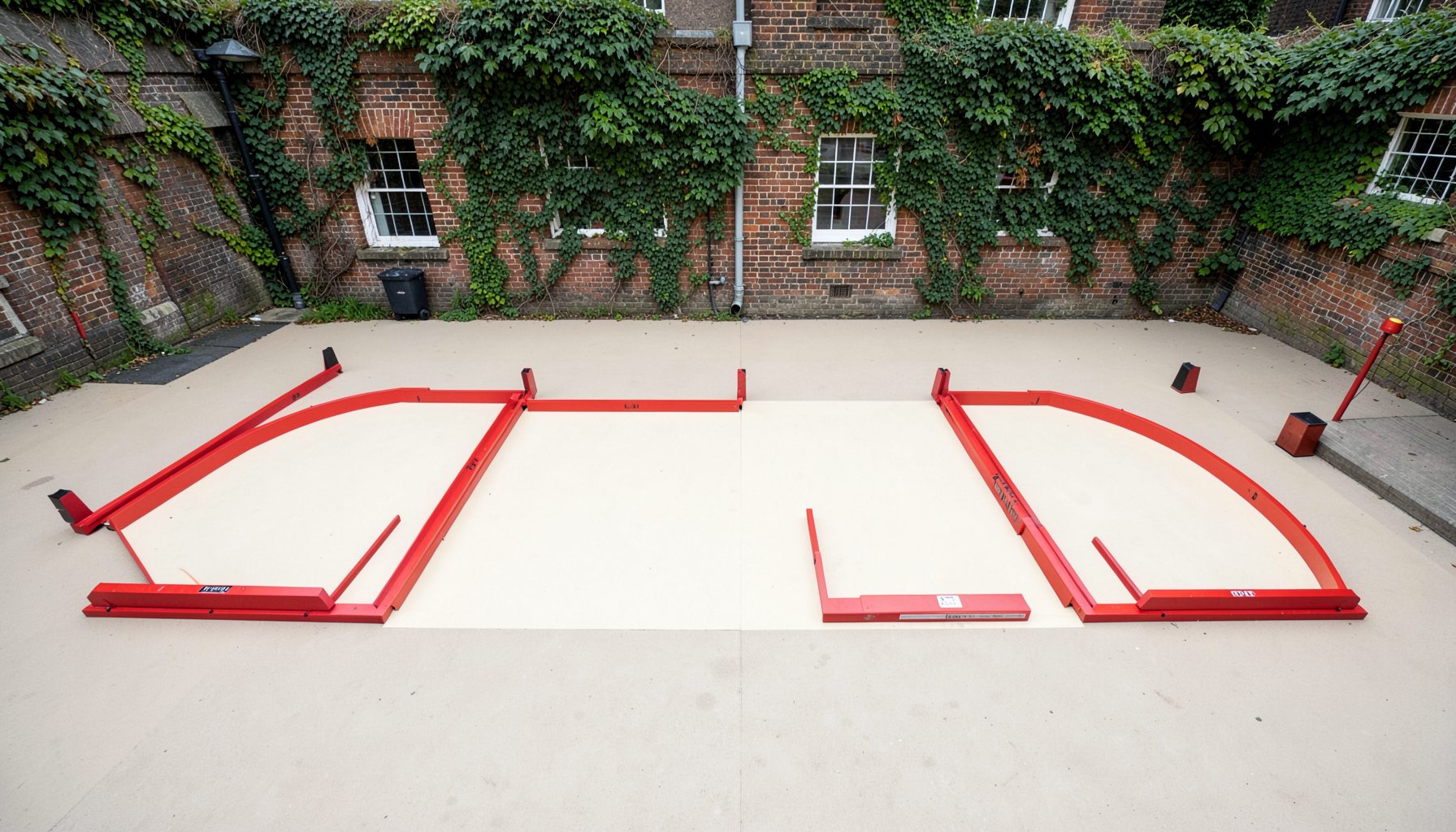
A Fives court could be built beside a school, college or institutional complex rather than on a large open parade ground. In a garrison town, that mattered. Land was often allocated to drill, stables, workshops, housing and administration, so an enclosed court could provide regular recreation without competing with major training spaces.
The game also worked well as a social activity. Players could meet before dinner, after duties or during a station’s organised recreation period. Like squash and racquets, Fives sat between exercise and club life, linking officers, instructors and students through fixtures and informal competition.
The surviving record is uneven because military participation was often documented through local newsletters, school magazines and club results rather than national sporting archives. A court may appear in a building plan, a memoir or a photograph without a complete account of who played there. This makes family papers, unit histories and association records valuable sources for reconstructing the sport’s service connections.
The First World War years
The First World War changed the meaning of organised recreation. Training camps needed activities that could break up long periods of drilling and waiting, while hospitals and convalescent centres searched for controlled forms of exercise. A court-based hand game could fit into this environment more easily than sports requiring extensive grounds or large numbers of players.
Fives was not a substitute for military training, and it should not be presented as a formal combat preparation system. Its contribution was more ordinary and human: maintaining fitness, routine and social contact. Games helped service personnel retain familiar habits in unfamiliar places, particularly when units were moved between Britain, France and other theatres.
The war also disrupted clubs and school networks. Players were enlisted, courts were repurposed and fixtures became difficult to arrange. Yet the same networks helped the game recover afterwards, as returning personnel brought memories, contacts and renewed interest to schools, universities and civilian clubs.
Between wars and during the Second World War
The interwar period allowed sporting institutions to rebuild. Military stations and training establishments continued to use games as part of recreation, although the popularity of Fives varied significantly from place to place. Its strongest foothold remained where a court already existed or where a senior player could organise regular sessions.
During the Second World War, compact sports gained renewed practical value. Airfields, coastal stations and temporary camps were busy environments, and recreation had to fit around shifts, alerts and changing accommodation. Fives could be played by a small group, with minimal equipment and no need to reserve a broad playing field.
The game also suited a wartime culture in which service organisations arranged competitions to support morale. Results might be reported locally rather than nationally, and many matches were probably never recorded. This explains why the historical picture contains clear institutional links but few complete statistics about military participation.
Australia’s place in the story
Australia inherited many sporting and educational traditions from Britain, including the use of school games to develop leadership and physical confidence. Cadet systems, military colleges and the officer-training environment created points of contact with British practices, although Rugby Fives never achieved the broad national reach of rugby union, cricket or tennis.
Canberra is an important setting for understanding this connection because the Australian Defence Force Academy and Royal Military College, Duntroon place training, education and fitness in close proximity. That does not make Fives a standard ADF activity, but it shows why a compact court sport could appeal in an institutional environment where time, space and structured participation matter.
The Australian market presents a different reality from Britain’s. A school in Sydney, Melbourne or Brisbane considering a court may need to balance construction costs against demand for more familiar sports, while specialist balls, gloves and coaching resources can be harder to source locally. Existing squash or multi-use spaces may therefore be relevant when clubs explore affordable pathways.
Australian law and policy also shape any modern programme. Coaches working with schools must consider state or territory child-safety requirements, while facilities and organised activities operate within Work Health and Safety frameworks, including the Commonwealth model and corresponding state legislation. Inclusive participation, supervision and safe court maintenance are part of responsible development.
Service memories and postwar change
After 1945, military sport changed as bases were reorganised, technology altered training and new fitness programmes gained attention. Television, motor travel and the growth of other racquet sports also changed recreational habits. In some places, a Fives court remained active because a committed group protected it; elsewhere, the building was converted or left unused.
The decline of a court did not erase its significance. Former service members carried knowledge of rules, techniques and local rivalries into civilian clubs. A story about a station tournament, a coach’s notebook or a photograph of players in uniform can reveal how the game functioned within a particular community.
For Australian researchers, this opens several practical avenues. Military museums, school archives, local newspapers and family collections may hold references to courts that do not appear in national sporting histories. ANZAC commemorations and regimental heritage projects can also provide useful opportunities to record sporting experiences alongside larger accounts of service life.
Preserving the record and renewing participation
The Rugby Fives Association has a role in bringing scattered evidence together. Results, fixtures, photographs and personal recollections can help show how the sport moved through schools, clubs and service communities. Accurate records are especially important for a niche sport, where a single court or long-running club may represent a significant part of local history.
The historical connection can support present-day coaching without turning the game into a museum piece. Young players do not need military backgrounds to enjoy the speed, tactics and physical challenge of Fives. A school programme in Perth or Adelaide, a community session in Sydney, or a heritage demonstration linked to a defence museum can each introduce the sport in a modern and welcoming way.
The strongest approach is inclusive rather than nostalgic. Military history should recognise the people who built, maintained and played on courts, while also acknowledging that access to sport has not always been equal. Current programmes can use the game’s compact format to welcome different ages and abilities, with qualified coaching and sensible safety procedures.
Rugby Fives offers a small but revealing window into the relationship between education, recreation and service. Its armed-forces history is made up of formal institutions, personal memories and practical adaptations, rather than a single uninterrupted military tradition.
Clubs, schools, researchers, veterans and families can help preserve that history by sharing photographs, fixture cards, oral accounts and court information with the Rugby Fives Association. To contribute a memory, explore the sport or discuss a local project, contact the association and help keep these connections active for the next generation.